

Online Workshop Resources
Floating Factories: Corporate Power, Communities, and Aquatic Food Systems
Pınar Ertör Akyazı is an associate professor at the Institute of Environmental Sciences, Boğaziçi University. She is an ecological economist working on fisheries, food sovereignty, biodiversity and political ecology of nature conservation. She worked as a research fellow for UNEP’s Global Environment Outlook (GEO-5) and EU-funded projects EJOLT (Environmental Justice Organizations, Liabilities and Trade) and ENTITLE (European Network of Political Ecology). She was a Mercator-IPC Fellow and post-doc researcher at the Istanbul Policy Center, Sabanci University. Her current work focuses on food systems and agroecology within the Horizon Europe FutureFoodS Project “Reshaping food systems: value change transformation through reconnection” (RESHAPE). She teaches undergraduate and graduate level courses such as Ecological Economics, Environmental Economics, Social Ecology and Research Methods. She is a member of the Co-Living Design Lab at the Istanbul Technical University.
Irmak Ertör is a political ecologist and an associate professor working at the Ataturk Institute for Modern Turkish History, Bogazici University, Istanbul, since 2019. Before her current position, she worked at the Institute of Environmental Science and Technology, Autonomous University of Barcelona (ICTA-UAB) as a postdoctoral researcher in the ERC-funded ENVJUSTICE project, focusing on global fisheries conflicts and environmental justice. She holds a BS in Economics and an MA in Modern Turkish History from Bogazici University, Turkey. She has been a Marie Curie (ITN) early-stage researcher of the ENTITLE project (European Network of Political Ecology) and completed her PhD on the "Political Ecology of Marine Finfish Aquaculture in Europe" at ICTA, UAB. Currently, she teaches political ecology, alternative economies, and gender history, as well as continues to do research on socio-environmental conflicts and social movements of fisher communities, community-supported fisheries, food systems and food sovereignty, blue economy/degrowth, and environmental/blue justice. She has research published in journals like the Journal of Peasant Studies, Journal of Agrarian Change, Marine Policy, and Global Environmental Change, among others, and she is an associate editor of the journal New Perspectives on Turkey.
Davide Mancini is a freelance environmental journalist. He has coordinated several cross-border investigations into issues including illegal fishing in the Mediterranean and West Africa, deforestation and wildfires, and plastic pollution. More recently, he has focused on food supply chains, exposing the environmental damage outsourced behind European food consumption, particularly in the fishery sector. He has been an Ocean Reporting Network's fellow at the Pulitzer Center in 2024/2025. His work has been featured in international media outlets in English, Italian, and Spanish. Before focusing on environmental journalism, he worked in Brussels for human rights NGOs, advocating within EU institutions. Mancini holds a master’s degree in journalism, with a specialisation in war and conflict reporting, from Aarhus University (Denmark) and Swansea University (UK).
The workshop was chaired by Mehroosh Tak (SOAS, University of London).
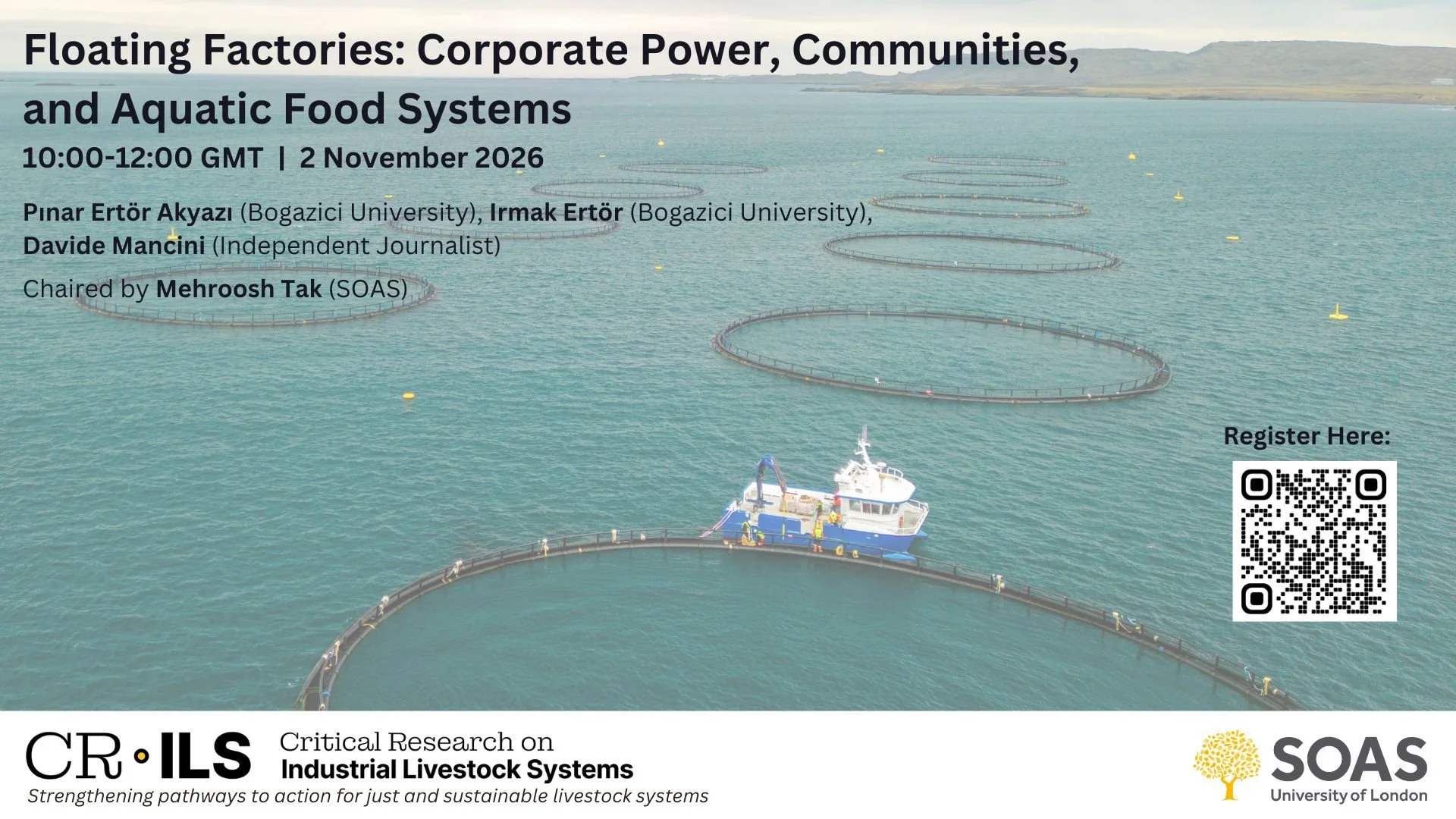
Recording of CRILS Online Workshop: Floating Factories, November 2026 (Zoom)